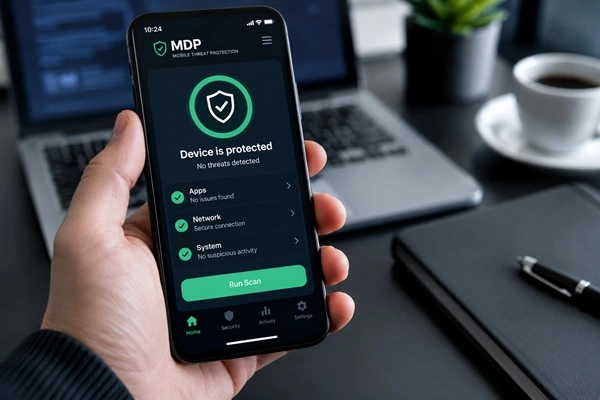
Smartphones have become one of the most important targets for modern cyberattacks. They contain private conversations, emails, photographs, contacts, passwords, business information, and access to online accounts. A successful attack can therefore compromise far more than the phone itself.
The problem is that many attacks are designed to remain unnoticed. A smartphone may appear to work normally even when malicious activity is taking place in the background.
This is where Endoacustica Europe introduces MDP, an advanced Intrusion Detection System for Android and iPhone designed to help detect suspicious activity and possible attempts to compromise a mobile device.
What Is MDP?
MDP is a mobile security system designed to prevent, detect, and help users respond to potential attacks affecting Android and Apple smartphones.
Unlike a traditional antivirus solution that focuses mainly on known malicious software, the system uses several detection techniques to identify unusual behavior involving the operating system, applications, and network connections.
This approach is particularly important because cyber threats are constantly evolving.
Attackers can exploit vulnerabilities in operating systems, applications, or communication protocols. In some cases, an attack may take advantage of a vulnerability that is not yet publicly known.
These vulnerabilities are commonly referred to as zero-day vulnerabilities.
Other attacks can require little or no interaction from the smartphone user. These are often described as zero-click attacks. They can be particularly difficult to detect because the victim may not need to click a link or install an application for the attack to begin.
How Does the Intrusion Detection System Work?
The system works through an application installed on the smartphone.
After the application has been installed and the license activated, it continuously analyzes different aspects of the device and looks for events that may indicate a security problem.
The system can examine the behavior of the operating system, applications, and network connections and identify patterns that differ from normal activity.
When a potentially dangerous event is detected, the user receives an alert and can be provided with recommendations about the actions that may be necessary.
This is an important difference between simply collecting security information and actually helping the user understand what is happening.
The objective is not to overwhelm the user with technical data.
The system is designed to turn complex security events into understandable warnings.
Protection Against Modern Mobile Threats
Smartphone attacks can take many different forms.
Malware can be hidden inside applications. Phishing attacks can arrive through email or messaging platforms. Malicious links can attempt to exploit vulnerabilities in applications or browsers. An attacker may also attempt to compromise a device through a vulnerable network connection.
For this reason, mobile security cannot be based on a single detection method.
MDP combines different security techniques, including behavioral analysis and machine learning, to look for suspicious events and patterns.
This approach can be particularly useful when dealing with threats that do not perfectly match the characteristics of previously identified malware.
Machine Learning and Behavioral Analysis
One of the technologies used by the system is machine learning.
Instead of relying exclusively on a fixed list of known threats, behavioral analysis can help identify activity that appears inconsistent with the expected behavior of the device, operating system, application, or network connection.
This is important because modern cyberattacks can change rapidly.
A security system that only looks for known signatures may have difficulty identifying completely new or modified threats.
Behavioral analysis takes a different approach by looking at what the device is doing and whether that activity presents characteristics associated with a possible compromise.
Phishing Protection
Phishing remains one of the most common ways attackers attempt to obtain access to sensitive information.
A malicious message can appear to come from a legitimate company, service, colleague, or contact. The message may contain a link designed to lead the user to a fraudulent website or another malicious resource.
Because smartphones are constantly used for email, messaging, and social media, phishing protection is an important part of mobile security.
MDP includes protection designed to help identify potentially dangerous phishing attempts received through supported communication channels.
Security When Using Public Networks
Connecting a smartphone to an unfamiliar Wi-Fi network can introduce additional security risks.
Public and open networks can be found in airports, hotels, restaurants, cafés, conference centers, and many other locations.
MDP includes connectivity security features designed to help users identify situations in which the network environment may increase the risk to the smartphone.
This is particularly relevant for people who frequently travel and need to connect their phones to different networks.
Checking the Security of the Device
A smartphone can become more vulnerable because of its own configuration.
Certain settings, permissions, applications, or outdated components may increase the potential attack surface of the device.
MDP can alert the user when specific device configurations may represent an increased security risk.
This gives the user an opportunity to review the situation and take corrective action before a security problem becomes more serious.
Application Security Analysis
Applications are another important part of smartphone security.
Users install applications for almost every aspect of their lives, from communication and banking to work, travel, entertainment, and social media.
However, every application adds another component to the smartphone environment that needs to be trusted and maintained.
MDP provides advanced application analysis to help identify potential risks associated with installed applications.
On compatible Android devices, users can also initiate an on-demand scan of an application to obtain additional security information.
What Happens If a Smartphone Is Compromised?
One of the most important functions of an intrusion detection system is identifying a possible compromise.
Detecting suspicious activity is only the first step.
The user also needs to understand what to do next.
When the system identifies an event that may indicate that the smartphone has been compromised, it can provide an alert together with recommendations for possible remediation.
This can help users react more quickly instead of trying to determine the cause of the problem without technical information.
Android and iPhone Protection
MDP has been designed to support both major smartphone platforms: Android and iOS.
This is important because mobile security cannot be approached in exactly the same way on every operating system.
Android and iOS have different architectures, security mechanisms, permissions, and application environments.
The available security functions can therefore vary according to the operating system and device.
Before choosing a mobile security solution, it is always important to verify compatibility with the specific smartphone model and operating system version.
Privacy by Design
Mobile security creates an important question: who can access the information collected by the security system?
MDP has been designed with a strong focus on privacy.
The system does not process personal or identifiable information for its security functions, helping to separate device security monitoring from the user’s personal content.
This approach is particularly important because a security application should protect the smartphone without becoming another source of unnecessary exposure of personal information.
How Effective Is the System?
The technology behind MDP has been evaluated in testing conducted by a German company specializing in the assessment of anti-intrusion systems.
According to the available test results, the system demonstrated a detection rate of more than 99% for the tested unknown attacks against Android smartphones when the devices were online, and more than 98% in offline testing.
These figures should be understood in the context of the specific tests performed and should not be interpreted as a guarantee that any security system can detect every possible attack.
Cybersecurity is a constantly changing field, and no protection technology can provide absolute protection against every future threat.
Why Mobile Intrusion Detection Matters
Traditional security solutions often focus on preventing known threats.
Modern smartphone attacks require a broader approach.
A device may be exposed through an application, a network connection, a phishing message, a vulnerability in the operating system, or a combination of different techniques.
This is why continuous monitoring of device behavior can provide an additional layer of protection.
The objective is not simply to ask whether malware is installed on the phone.
The more important question is:
“Is the smartphone behaving as it should?”
This is the principle behind intrusion detection and behavioral security.
Who Can Benefit From MDP?
Mobile intrusion detection can be particularly relevant for people who handle sensitive information or regularly use their smartphones in environments where cybersecurity is a major concern.
Potential users may include:
- business professionals;
- executives and managers;
- people handling confidential information;
- traveling professionals;
- security-conscious private users;
- organizations that need additional protection for mobile devices.
The actual suitability of the system depends on the smartphone, operating system, security requirements, and intended use.
A Different Approach to Smartphone Security
The main purpose of an intrusion detection system is not to make the smartphone more complicated.
It is to provide the user with information that would otherwise be difficult to obtain.
A smartphone can look perfectly normal while a sophisticated attack is taking place in the background. Detecting unusual behavior can therefore provide an additional layer of awareness.
With machine learning, behavioral analysis, application analysis, phishing protection, connectivity security, and compromise detection, MDP approaches smartphone security from several different angles.
Endoacustica Europe and Mobile Security
Endoacustica Europe provides professional technologies for security, surveillance, and protection.
Our experience in the security sector allows us to work with customers who require specialized solutions rather than standard consumer products.
MDP represents a different type of mobile security technology: instead of monitoring the activities of a smartphone, its purpose is to monitor the security of the device itself and identify signs that could indicate an attempted compromise.
For more information about the Intrusion Detection System for Android and iPhone, contact Endoacustica Europe.
Tel. +39 080 3026530
WhatsApp: +39 3457502269
Important Information
Cybersecurity systems cannot guarantee protection against every possible attack. Detection capabilities depend on the smartphone model, operating system, software version, network conditions, and other technical factors.
The system should therefore be considered an additional security layer rather than a guarantee of absolute protection.