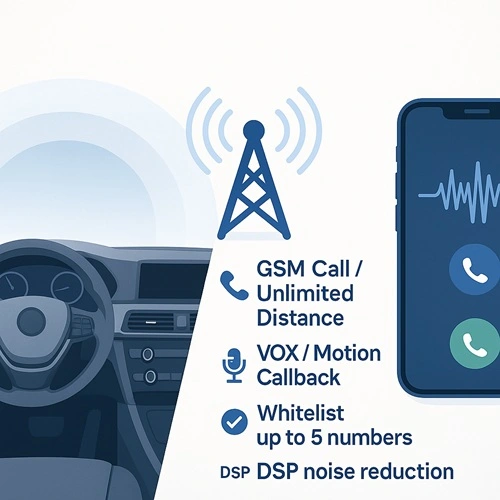
When a vehicle operates outside Wi-Fi coverage or in areas with unstable data, a quad-band GSM bug enables unlimited-distance ambient listening through a standard voice call. This guide explains when to prefer GSM, how to configure VOX/motion with auto-callback and SMS, and best practices for lawful, reliable use in vehicles.
Legal note: use is allowed only for lawful purposes and in compliance with applicable regulations; where required, always obtain prior consent from the parties involved.
When to choose GSM instead of Wi-Fi
- Unlimited reach: the mobile network follows the vehicle; no reliance on hotspots, captive portals, or Wi-Fi handovers.
- Operational simplicity: no app, no pairing. Insert a SIM (PIN disabled), place the device, call and listen hands-free.
- Resilience: VOX/motion alarms with callback and/or SMS trigger even where data service is weak or restricted.
How NANO-BUG works in a vehicle
The NANO-BUG — GSM Quad-Band Spy Transmitter uses 850/900/1800/1900 MHz for live ambient listening via an incoming call. A dedicated DSP improves speech intelligibility by reducing hiss and background noise; alarms can be VOX (voice) and/or motion with adjustable thresholds and auto-callback plus SMS. Access is restricted via a whitelist of up to 5 numbers.
Operational setup (quick start)
- SIM: activate a voice/SMS plan and disable the PIN.
- Whitelist: store up to five authorized numbers for calls and commands.
- VOX/motion: enable alarms and set an initial threshold (medium–low), then fine-tune after tests.
- Callback / SMS: choose whether to receive an auto-callback, an SMS alert, or both on threshold exceedance.
- Power: use the rechargeable battery for short sessions; for long missions, use the 12 V vehicle kit or continuous power modules.
- Field test: make a test call in multiple conditions (city/rural) and verify audio and sensitivity.
These guidelines are general and for lawful use only; avoid concealment instructions or any illegal applications.
Tuning VOX sensitivity on the move
Acoustic conditions change with the cabin, speed, rain, and road surface. Use this practical guide:
| Scenario | Suggested threshold | Notes |
|---|---|---|
| Parked vehicle | Medium → Low | Reduces false positives from occasional vibrations. |
| Urban traffic | Medium | Moderate but variable background (doors, horns). |
| Highway / heavy rain | Medium–High | Continuous noise floor; raise threshold to avoid nuisance callbacks. |
Vehicle best practices (no concealment details)
- Avoid direct vibrations (fans, thin metal panels, window frames).
- Reduce continuous noise (keep distance from air ducts or speakers).
- Test with the vehicle closed: acoustic response differs from an open cabin.
- Verify coverage: some rural segments have weak signal; choose the best carrier for the route.
Quick troubleshooting
- No callback: check VOX/motion threshold, credit/SMS balance, and coverage.
- Muffled audio: try small re-positions to escape resonant spots.
- Too many alarms: raise the threshold gradually and disable unnecessary confirmations via SMS.
- Run-time: for long shifts, prefer 12 V or mains adapters.
Operational checklist
- Voice/SMS SIM active, PIN disabled
- Whitelist of authorized numbers configured
- VOX/motion enabled with scenario-appropriate threshold
- Callback/SMS on event configured
- Power sized to mission length (battery / 12 V)
- Tests in multiple conditions (parked/urban/highway)
FAQ
Does it require mobile data?
No. Voice and SMS are sufficient. The call handles live listening; SMS handle configuration and alerts.
How many numbers can I authorize?
Up to five numbers in a whitelist for listening and remote commands.
Can it record audio?
NANO-BUG is a live listening device over GSM. For local recording, consider a dedicated micro voice recorder in compliance with the law.
How long does the battery last?
It depends on usage (alarms/calls). For extended missions, use the vehicle 12 V adapter or mains modules.
Is it legal to use?
Only for lawful purposes and in accordance with applicable regulations; where required, prior consent is necessary. If unsure, seek legal advice.