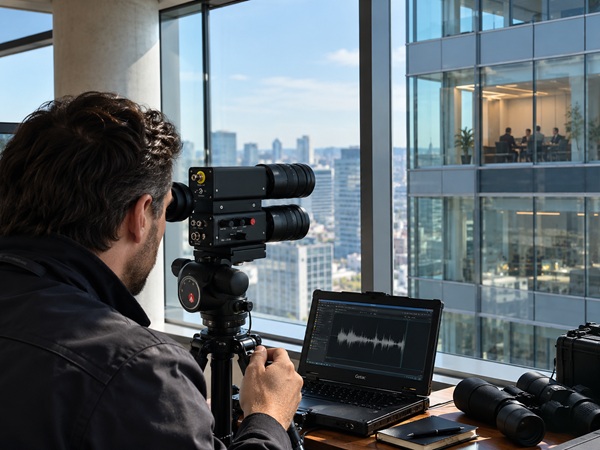
Article originally published in 2009 and updated September 10, 2026. This article has been updated with technical information on laser microphones, remote audio detection, and the evolution of optical sensing technology.
A laser beam can be used to detect tiny vibrations produced by sound on a surface. This is the basic principle behind a laser microphone, a specialized technology that can capture audio information without placing a conventional microphone inside the area being monitored.
The concept may sound like something from a spy movie, but the underlying physics is real. When someone speaks inside a room, the sound waves can cause extremely small vibrations in nearby surfaces. A window, for example, may vibrate in response to the sound inside the room. An optical system can detect these tiny movements and use them to reconstruct information related to the original sound.
This makes the laser microphone very different from a conventional microphone and particularly interesting in applications where contact with the surface being measured is not desirable.
What Is a Laser Microphone?
A laser microphone is a non-contact audio sensing system that uses a laser and an optical receiver to measure vibrations on a surface.
A conventional microphone works by directly detecting changes in air pressure caused by sound. A laser microphone takes a different approach. Instead of measuring the sound directly in the air, it measures the movement of a surface that responds to those sound waves.
That surface may be glass, a wall, or another object capable of vibrating in response to acoustic energy.
Scientific research into laser-based speech sensing describes this type of technology as a non-acoustic method of detecting speech by measuring mechanical vibrations produced on an object.
Why Can Glass Carry Information About Sound?
When a person speaks, the voice creates pressure variations in the surrounding air.
Those sound waves reach the surfaces inside the room, including windows. The glass can respond with extremely small mechanical vibrations. These movements are normally invisible to the human eye, but sensitive optical equipment can detect them.
The important point is that the laser is not traveling through the glass and directly recording the voice.
Instead, the system measures the vibration of the glass. That vibration contains information related to the sound produced inside the room.
The process can therefore be simplified as:
sound → vibration of the surface → optical measurement → electronic signal → audio information
This is what makes the technology so interesting from an engineering standpoint.
How Does a Laser Microphone Detect Vibrations?
The system directs a laser beam toward a surface and analyzes the light reflected back toward the receiver.
When the surface moves, even by an extremely small amount, the reflected optical signal changes. Depending on the design of the system, the equipment can analyze changes in phase, frequency, position, intensity, or other properties of the reflected light.
Some systems use interferometric techniques, while others use laser Doppler or related optical measurement methods.
The resulting signal can then be processed electronically to extract information associated with the vibration.
Modern research continues to investigate different optical techniques for remote speech sensing, including laser Doppler vibrometry, laser microphones and interferometric systems.
The Laser Does Not “Hear” Through the Window
This is one of the most important points to understand.
A laser microphone does not work like a normal microphone placed on the other side of a window.
The laser itself does not carry the conversation from inside the room. Instead, the optical system measures mechanical movement on the surface of the glass.
The glass effectively becomes part of the sensing system.
The sound produced inside the room causes the glass to vibrate. The optical equipment detects those vibrations and converts the measurements into an electrical signal that can then be analyzed.
This is why the technology is based on both optics and vibration measurement, rather than audio amplification alone.
Why Is Glass Such an Interesting Surface?
Windows are particularly interesting because they provide relatively large surfaces that can respond mechanically to sound.
However, not every window behaves in the same way.
The thickness of the glass, its dimensions, the frame, the number of panes and the mechanical characteristics of the window can all affect its response to sound.
The same applies to the way the window is mounted. A rigidly supported pane and a larger, more flexible pane may respond differently to the same acoustic stimulus.
This means that the performance of a laser microphone cannot be determined simply by looking at the nominal distance of the system.
The physical properties of the target surface matter just as much.
Reflectivity Also Matters
The optical characteristics of the target surface are another important factor.
The laser needs to produce a usable reflected signal for the receiver. A surface with favorable reflective characteristics can make the measurement easier, while poor reflectivity or an irregular surface can make the optical signal more difficult to analyze.
Recent research into laser-based speech sensing also highlights the importance of the target surface and its optical properties when attempting to recover speech from remotely measured vibrations.
This is one reason why real-world performance can differ substantially from laboratory demonstrations.
Distance and Alignment Are Critical
Distance is one of the most misunderstood aspects of laser microphone technology.
There is no universal distance at which every laser microphone will produce the same results.
Actual performance depends on the optical system, the target surface, atmospheric conditions, alignment, geometry and the quality of the signal received by the sensor.
Alignment is particularly important. The laser and receiving optics must maintain the correct relationship with the target surface. Even relatively small changes in the geometry can affect the quality of the optical measurement.
Environmental vibration can create another problem. Buildings, traffic, machinery, air-conditioning systems and other sources of vibration may introduce signals that have nothing to do with the speech being measured.
For this reason, professional evaluation of a laser microphone should consider the complete operating environment rather than focusing only on a manufacturer’s maximum distance figure.
Laser Microphone vs. Conventional Microphone
The main difference between the two technologies is simple:
A conventional microphone detects sound directly. A laser microphone measures vibration remotely.
A conventional microphone must be physically positioned where the sound is being measured.
A laser microphone can perform its measurement without physically attaching a sensor to the target surface.
This makes optical vibration measurement useful not only in security-related applications, but also in engineering, scientific research, vibration analysis and other situations where contact with the object is undesirable.
Laser Doppler vibrometry, for example, is widely used as a non-contact method for measuring surface vibration.
Is Laser Microphone Technology Still Relevant?
Yes.
The basic principle has been known for decades, but research into optical speech sensing is still active.
Modern systems benefit from advances in optical sensors, electronics, digital signal processing and computing power. Researchers are also investigating ways to improve speech reconstruction using advanced signal-processing techniques and machine learning.
Recent work continues to examine laser-based methods for extracting speech-related information from surface vibrations.
This is an important distinction: the technology is not simply an old spy device from the early 2000s. The underlying physical principle remains relevant, while the electronics and signal processing around it continue to evolve.
From Optical Measurement to Digital Signal Processing
The optical measurement is only the first part of the process.
Once the receiver detects the vibration signal, the system can use electronic and digital processing to isolate useful information.
Depending on the system, signal processing may include filtering, noise reduction, frequency analysis and other techniques designed to improve the usable signal.
This becomes particularly important when the vibration generated by speech is extremely small compared with background vibration.
Modern research is also exploring machine-learning techniques for improving the reconstruction of speech from remotely detected vibrations.
However, advanced processing does not eliminate the physical limitations of the measurement.
A sophisticated algorithm cannot completely compensate for a poor optical signal, severe environmental vibration or unfavorable target conditions.
The Real Limitations of a Laser Microphone
Movies often make laser microphones look almost magical: point a laser at any window from any distance and hear a conversation perfectly.
Real systems are much more complicated.
Performance can be affected by:
- distance between the optical system and the target;
- optical alignment;
- surface reflectivity;
- glass thickness and construction;
- window size and mechanical characteristics;
- building and environmental vibrations;
- atmospheric conditions;
- background noise;
- quality of the optical receiver;
- signal-processing capabilities.
For this reason, claims about maximum operating distance should always be considered in relation to the conditions under which that distance was obtained.
A system that performs well under controlled conditions may produce very different results in a complex real-world environment.
Laser Microphones and Building Security
Laser-based sensing introduces an interesting consideration for the security of sensitive environments.
Traditional electronic surveillance detection focuses primarily on devices physically located inside a room: microphones, transmitters, cameras, recorders and other electronic equipment.
A remote optical system works according to a different principle.
Because the measurement can be performed without physically installing a conventional microphone in the room, security assessments for particularly sensitive environments may also need to consider the building’s external surfaces and windows.
This does not mean that every window represents a practical security vulnerability. It means that physical and electronic security should be evaluated according to the technologies that could realistically be used in a specific environment.
How Can Sensitive Rooms Be Better Protected?
For high-security environments, protecting a room from unwanted audio collection involves more than simply searching for electronic devices.
The physical characteristics of the room can also matter.
Large windows, lightweight structures and other surfaces that respond strongly to acoustic energy may deserve particular attention when a facility requires a high level of confidentiality.
Technical security assessments can therefore consider:
- window construction;
- glass type;
- acoustic characteristics;
- structural vibration;
- room layout;
- external observation points;
- possible optical measurement paths.
The objective is not simply to identify a specific device, but to understand how information could potentially leave a protected environment.
A Technology That Predates Today’s Smartphones
The laser microphone is an interesting example of how some surveillance technologies developed along a completely different path from today’s smartphone-based systems.
The original Endoacustica article was published in 2009, when smartphones were only beginning to become a mass-market technology.
The concept described at the time was already based on the same fundamental principle: using a laser to detect extremely small vibrations on a surface and converting those measurements into information associated with sound.
Since then, optical sensors, electronics and digital signal processing have advanced significantly.
The fundamental physics, however, remains the same.
A sound produces a mechanical response. The optical system measures that response without physically touching the surface.
Why Professional Evaluation Matters
A laser microphone should not be evaluated simply by its appearance or by a single specification such as maximum range.
For professional applications, the complete system needs to be considered.
The optical design, receiver sensitivity, stability, signal processing, target characteristics and operating environment all contribute to the final result.
This is particularly important because two apparently similar systems can perform very differently under real operating conditions.
For this reason, technical consultation is often more useful than relying solely on a distance figure printed on a specification sheet.
Conclusion
A laser microphone uses optical measurement to detect extremely small vibrations produced on a surface by sound. When that surface is a window, the system can potentially extract information related to speech without placing a conventional microphone inside the room.
The technology is based on a fascinating combination of acoustics, mechanics, optics and digital signal processing.
It is also important to separate engineering reality from the way laser microphones are portrayed in movies. They do not provide unlimited range or perfect audio under every condition. Distance, alignment, surface characteristics, reflectivity, vibration and environmental conditions can all have a major impact on performance.
The principle, however, remains highly relevant. Research published in recent years continues to investigate optical methods for remote speech sensing and vibration measurement.
The original Endoacustica article from 2009 described this technology at a time when digital surveillance was very different from today. More than a decade later, the underlying physical principle remains the same, while the sensors, electronics and signal-processing techniques have become considerably more sophisticated.
Legal notice: Audio surveillance and remote sensing technologies must always be used in accordance with applicable laws, privacy regulations and rules governing the confidentiality of communications. Technical capability does not automatically imply a legal right to record, intercept or use a communication.
Last updated: September 10, 2026.