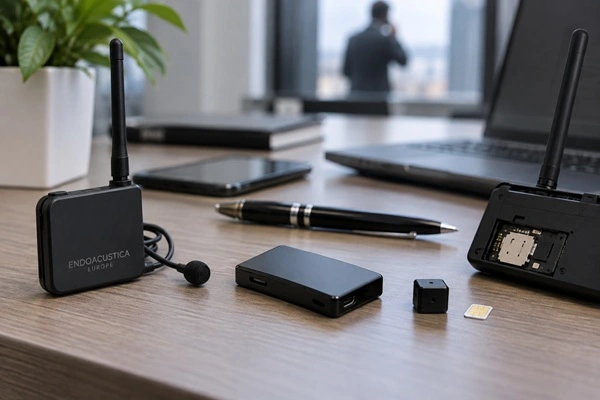
Audio surveillance technology has evolved significantly over the years. What once required large and specialized equipment can now be achieved with compact professional devices designed to capture and transmit audio in different operating environments.
However, before choosing any type of listening device, it is important to understand how the different technologies work and, above all, to use them only for purposes permitted by applicable laws. Unauthorized recording or interception of private conversations can violate privacy and other legal protections.
When used within an appropriate legal framework, professional audio surveillance equipment can be useful in specific security, investigative, and monitoring applications. The right solution depends on the environment, the required transmission distance, the available power source, and whether the system needs to operate locally or remotely.
What Is a Spy Bug?
A spy bug, also known as a listening device or covert audio transmitter, is a compact electronic system designed to capture sounds and transmit or store audio.
A typical system can include a sensitive microphone, an electronic processing circuit, a power source, and a method for transmitting or recording the captured audio.
The microphone converts sound into an electrical signal. Depending on the type of device, that signal can then be transmitted wirelessly, sent through a cellular network, stored in internal memory, or processed by another connected system.
This means that the term “spy bug” does not refer to one specific technology. There are several different types of professional listening devices, each designed for different operating conditions.
What Are the Main Types of Spy Listening Devices?
Professional audio surveillance systems can be divided into several broad categories. The most appropriate choice depends on how the equipment is intended to be used and the environment in which it must operate.
RF and Radio Frequency Listening Devices
Professional spy listening devices can use radio-frequency transmission to send captured audio to a compatible receiver.
These systems can be designed around different frequency bands and transmission technologies. Professional models may use UHF or VHF frequencies, while more advanced digital systems can incorporate encrypted transmission to protect the communication between the transmitter and receiver.
The main advantage of an RF system is that the audio does not necessarily have to pass through a cellular or Internet connection. The transmitter communicates directly with its receiver within the operating range of the system.
The effective range depends on several factors, including transmitter power, antenna configuration, obstacles, interference, and the environment in which the equipment is being used.
Analog and Digital Listening Devices
Radio-frequency listening devices can also use either analog or digital transmission.
Analog systems transmit the audio signal in analog form. They can be relatively simple and can offer good performance in suitable conditions.
Digital systems convert the audio into digital data before transmission. This allows manufacturers to implement more sophisticated signal processing and, in professional systems, encryption and other security measures.
The difference is therefore not simply a question of transmission distance. Signal security, audio quality, resistance to interference, receiver technology, and the intended application can all influence the choice between analog and digital equipment.
GSM Listening Devices
GSM listening devices work differently from traditional RF transmitters.
Instead of transmitting audio directly to a nearby dedicated receiver, a GSM device uses a cellular network to establish a remote connection.
This makes the concept particularly interesting when the person authorized to access the system is located far away from the device.
The practical operating distance is therefore not determined in the same way as with a conventional radio transmitter. Where cellular coverage is available and the device is correctly configured, communication can take place over much greater distances.
GSM technology has historically been used in compact audio monitoring devices because cellular networks provide a convenient way to establish remote communication.
Modern cellular-based systems, however, may use newer mobile network technologies depending on the device and the networks available in the area.
3G and 4G Audio Monitoring Systems
As mobile networks evolved, audio monitoring technology also moved beyond traditional GSM systems.
Devices using newer cellular networks can provide improved connectivity and, depending on the specific system, support additional functions that were not practical with earlier generations of mobile technology.
Modern cellular monitoring equipment can therefore be significantly more sophisticated than the GSM devices that were common when these technologies first appeared.
For this reason, when evaluating an older GSM-based system, it is important to check which mobile networks are currently available in the country where the equipment will be used.
What Is the Difference Between Analog and Digital RF Systems?
Analog and digital RF systems can both be used for wireless audio transmission, but they operate differently.
With an analog system, the audio signal is transmitted directly as an analog radio signal. A compatible receiver can then reproduce the audio.
A digital system converts the audio into digital information before transmission. This creates additional possibilities for signal processing, error correction, authentication, and encryption.
For professional applications where confidentiality is important, digital encrypted systems can offer significant advantages over conventional analog transmission.
The choice should therefore not be based only on transmission range.
Other factors should also be considered:
- audio quality;
- transmission security;
- resistance to interference;
- receiver technology;
- operating range;
- battery life;
- size and portability;
- the environment in which the system will be used.
How Does a Professional Listening Device Capture Audio?
The basic principle is straightforward.
A microphone detects sound waves and converts them into an electrical signal. The electronics inside the device then process the signal according to the type of system.
In a simple RF transmitter, the processed signal can be transmitted directly to a compatible receiver.
In a digital system, the audio can be converted into digital data and processed before being transmitted.
A cellular-based device follows another approach, using a mobile network to establish remote communication.
Some systems can also incorporate internal memory, allowing audio to be recorded locally instead of being transmitted continuously.
This is one of the most important differences between professional listening devices: not every system needs to transmit audio in real time.
Real-Time Audio or Local Recording?
The intended application can determine whether live transmission or local recording is more appropriate.
A real-time system allows authorized users to receive audio while the device is operating. This can be useful when immediate information is required.
A recording device, on the other hand, stores the audio internally and allows it to be retrieved later.
Some professional systems can combine both approaches, depending on their configuration.
When choosing equipment, it is therefore useful to consider whether the priority is immediate remote access, long recording time, high audio quality, or a combination of these functions.
Why Audio Quality Matters
Having a microphone that can technically capture sound is not enough.
The quality of the recording depends on the microphone itself, the electronics used to process the signal, background noise, the acoustic characteristics of the environment, and the transmission or recording technology.
Professional listening devices can use high-sensitivity microphones and optimized audio circuits to obtain clearer recordings under suitable conditions.
However, no microphone can eliminate the limitations imposed by a difficult acoustic environment.
Walls, machinery, traffic, ventilation systems, distance, and background conversations can all affect the final audio quality.
Choosing the Right Listening Device
There is no single “best” spy bug for every application.
The correct system depends on the actual requirements.
A short-range RF transmitter may be appropriate when a dedicated receiver is available nearby. A digital encrypted system may be preferable when transmission security is a priority. A cellular-based solution may make more sense when remote access over a large geographic area is required.
Other factors can be equally important.
- Transmission range: how far the receiver or remote connection needs to be from the device.
- Power supply: whether the system can use an external power source or requires a battery.
- Operating time: how long the equipment needs to remain active.
- Audio quality: whether the system is intended for speech or more general environmental audio.
- Security: whether the transmitted information needs to be protected against unauthorized reception.
- Connectivity: whether the system relies on RF, cellular networks, or another communication method.
Professional Audio Surveillance Technology
Professional audio surveillance has changed considerably since the first generations of electronic listening devices appeared.
Modern equipment can be smaller, more efficient, and more sophisticated than older systems. Digital signal processing, improved microphones, encrypted communication, cellular networks, and longer-lasting batteries have all contributed to this evolution.
At the same time, miniaturization has made it possible to develop devices for applications where portability is important.
The technology can therefore range from simple audio transmitters to advanced systems incorporating multiple communication and recording functions.
Why Technical Support Is Important
Choosing the right equipment is only the first step.
Professional audio systems can have very different technical characteristics, and selecting the wrong technology for a particular environment can lead to poor results.
Transmission distance, radio interference, network availability, power consumption, microphone sensitivity, and receiver compatibility all need to be considered.
This is why professional technical advice can be particularly useful before purchasing a listening device.
A specialist can help determine which type of system is appropriate instead of simply recommending the device with the longest advertised range or the largest number of features.
Spy Bugs: Technology Has Changed, but the Basic Principle Remains
The concept behind a listening device has remained relatively simple for decades: capture sound and make that audio available to an authorized user.
What has changed is the technology used to accomplish this.
Older systems relied heavily on basic analog radio transmission. Modern solutions can use digital processing, encrypted communication, cellular networks, internal memory, and advanced microphones.
This evolution has made professional audio surveillance equipment more flexible and suitable for a wider range of legitimate security and investigative applications.
Endoacustica Europe: Professional Listening Devices
Endoacustica Europe has more than 20 years of experience in professional security and surveillance technologies.
We provide a range of audio surveillance solutions, including RF, digital, and cellular-based systems, depending on the customer’s specific requirements.
Our support includes assistance with product selection, technical specifications, configuration, testing, and after-sales support.
For more information about professional spy listening devices, contact Endoacustica Europe.
Tel. +39 080 3026530
WhatsApp: +39 3457502269
Responsible Use of Listening Devices
Listening and audio monitoring technologies can involve highly sensitive personal information. Their use must therefore comply with applicable laws and privacy regulations.
Recording, intercepting, or monitoring private conversations without the necessary authorization may be unlawful.
Before using any listening device, users should verify the legal requirements applicable to their specific situation and ensure that the system is used only for an authorized and legitimate purpose.