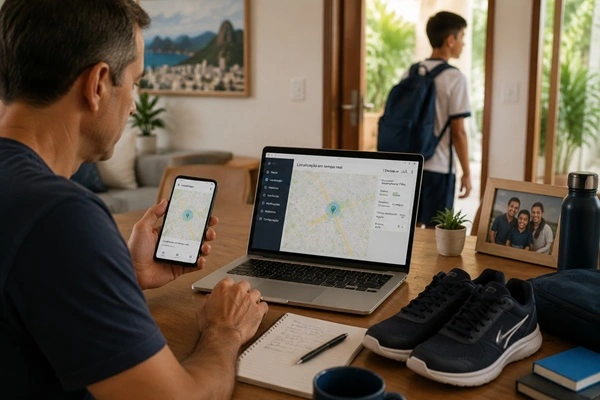
When children become more independent, many families face a new challenge: finding the right balance between freedom and safety.
Going to school, attending sports activities, meeting friends, or moving around the city are normal parts of a teenager’s daily life.
However, in some countries and environments, parents may have additional concerns about their children’s safety when they are away from home.
This was the situation of a family living in Brazil that contacted Endoacustica Europe looking for a reliable solution to improve the safety of their child’s daily movements.
Their request was simple:
They wanted a way to quickly know where their child was located in case of an emergency or an unusual situation.
The goal was not to constantly control the child’s activities.
The goal was to have an additional safety tool available when needed.
A Family Concerned About Daily Movements
The family lived in Brazil, in an environment where personal security was an important consideration in everyday life.
In some areas of the country, concerns related to crime and personal safety have encouraged many families, especially those with greater exposure, to pay closer attention to their children’s movements when they begin traveling independently.
For this family, the concern was not about limiting their child’s independence.
They wanted a practical solution that could provide additional information if something unexpected happened.
A delayed arrival.
An unusual route.
A phone call that was not answered.
A situation where the parents simply needed to know the child’s location.
The question was:
“If we needed to know where our child was, would we have a reliable way to find out quickly?”
Understanding the Real Need Before Choosing the Technology
One of the most important steps in providing a professional solution is understanding the customer’s actual situation.
Every family has different habits, different routines, and different needs.
Before suggesting a system, we analyzed how the teenager moved during the day.
The smartphone was already an important part of his routine.
Like most teenagers, he used it for communication, applications, and everyday activities.
For this reason, the first solution considered was a smartphone-based GPS location system.
A smartphone is often the most practical option because it is already carried by the person during daily activities.
However, the family also wanted to consider an additional level of protection.
A smartphone, while useful, has some limitations.
The battery can run out.
The phone can be forgotten at home.
The device may not always be available.
For this reason, we looked for a solution that could work together with the smartphone rather than depending only on it.
The First Solution: A Smartphone with GPS Location and Remote Access
The first step was configuring a smartphone with a professional location system.
The device was prepared with the necessary settings and connected to a secure remote platform.
The system included:
- real-time GPS location;
- location history;
- route tracking;
- geofence areas;
- automatic notifications;
- remote access through a web dashboard.
This allowed the family to check the smartphone’s location whenever necessary.
Instead of repeatedly calling the teenager to ask:
“Where are you?”
“Have you arrived?”
“Why are you late?”
the family had access to a direct and immediate reference.
The technology provided information when needed without interfering with normal daily activities.
Why Location History Was Important
Real-time GPS location shows where a device is at a specific moment.
However, location history provides a broader picture.
This difference can be very important.
A parent may notice that a child’s routine has changed.
Maybe the usual route is different.
Maybe arrival times are becoming inconsistent.
Maybe the child is spending more time in unexpected areas.
The purpose of reviewing location history is not to analyze every movement.
It is to understand patterns and identify situations that are different from normal.
Having objective information can help parents make better decisions instead of relying only on assumptions or worry.
Geofence Notifications for Automatic Alerts
Another useful feature configured for the family was geofencing.
A geofence creates a virtual area on a digital map.
For example, parents can define areas such as:
- home;
- school;
- sports facilities;
- other regular locations.
When the smartphone enters or leaves one of these areas, the system can send an automatic notification.
This makes the solution easier to use because parents do not need to constantly open the dashboard and check the position manually.
The system provides information when a specific event occurs.
For many families, this is the most practical approach.
The technology remains in the background and only becomes important when there is a reason to check.
A Higher Level of Security: A GPS Device Integrated Into Shoes
During the consultation process, the family explained that they wanted an additional safety layer.
They were looking for a solution that would not depend completely on the smartphone.
The reason was simple.
A phone is useful, but it is still an electronic device that can be forgotten, lost, or left without battery power.
We therefore analyzed the teenager’s daily habits to find a more suitable option.
During this conversation, an interesting detail emerged.
The teenager regularly wore a specific style of sports shoes that he liked and used almost every day.
This created an opportunity to design a customized solution.
A compact GPS tracking device could be integrated into the shoe, creating an additional location system independent from the smartphone.
A Solution Designed Around Real-Life Habits
One of the biggest challenges with any technology is making sure it fits naturally into the user’s routine.
A device that is forgotten or not used correctly cannot provide the expected benefit.
The advantage of this approach was that the solution was connected to something the teenager already used every day.
The shoes were already part of his normal routine.
The GPS device provided an additional reference point without requiring another action from the user.
The family also prepared a second pair of the same style of shoes with an equivalent system already configured.
This ensured continuity if the original pair needed to be replaced.
Instead of starting the process again, the family had another prepared solution available.
Two Different Technologies Working Together
The final solution combined two complementary technologies.
The smartphone represented the main daily tool.
It provided:
- communication;
- GPS location;
- route history;
- geofence notifications;
- remote access.
The GPS device integrated into the shoes represented an additional safety layer.
It was not designed to replace the smartphone.
It was designed to provide another option in situations where the phone might not be available.
This approach demonstrates an important principle:
The best technology is not always the one with the most features.
It is the one that best fits the real needs and habits of the person using it.
The Result: More Peace of Mind for the Family
After the system was configured, the family had a more complete solution for managing daily safety concerns.
They could check the smartphone location when necessary and rely on an additional GPS solution for extra reassurance.
The main benefit was not constant monitoring.
The benefit was having reliable information available in situations where it could make a difference.
For example:
- unexpected delays;
- unusual changes in routine;
- situations where communication was not immediately possible;
- emergencies requiring quick information.
The technology became a support tool designed around a specific family need.
Technology and Responsibility
Location technologies must always be used responsibly and according to applicable laws and privacy regulations.
When these systems involve children, parents or authorized guardians must ensure that their use has a legitimate purpose and respects privacy requirements.
Technology should not replace communication between parents and children.
It should not eliminate trust.
Instead, it can provide an additional layer of support for families who want to improve safety during specific situations.
Customized Security Solutions for Unique Needs
This case shows an important aspect of professional technology solutions:
not every situation can be solved with a standard product.
For some families, a smartphone-based GPS system may be enough.
For others, a combination of different technologies may provide a better solution.
At Endoacustica Europe, the approach starts with understanding the customer’s real needs and then selecting the most appropriate technology.
The final solution is not simply a device.
It is a system designed around a specific situation, a specific routine, and a specific security requirement.
In this case, the combination of smartphone location technology and an additional GPS solution provided the family with greater confidence during their child’s daily movements.