Company smartphones are essential tools for sales teams working in the field. They are used to contact customers, communicate with the office, manage appointments, access business apps, and navigate between locations.
But when a company manages dozens of smartphones at the same time, a simple question becomes more difficult to answer:
How are these devices actually being used during the workday?
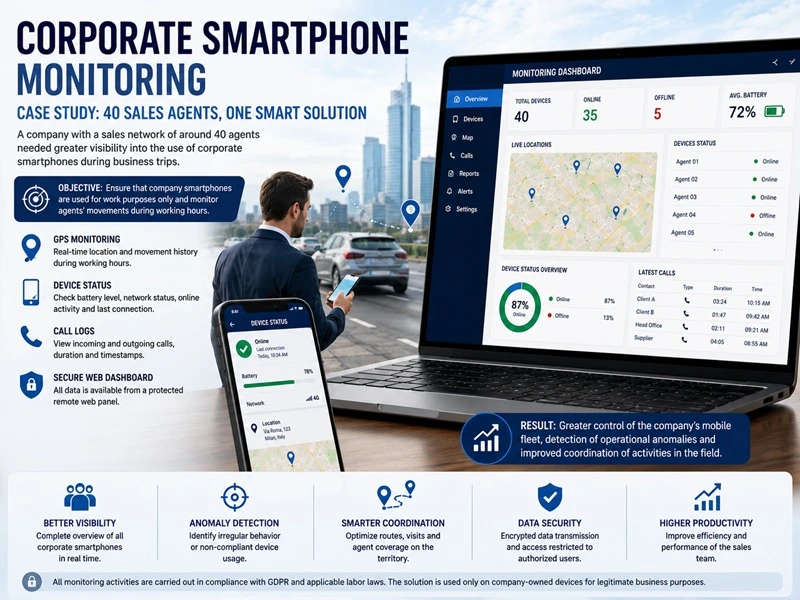
This was the challenge faced by a company with a sales network of approximately 40 agents working across different areas.
The company contacted Endoacustica Europe to implement a centralized corporate smartphone monitoring system for its Android devices.
The goal was clear: improve visibility over company-owned smartphones, monitor their location during working hours, and identify unusual activity that could affect daily operations.
The Challenge: Managing 40 Smartphones in the Field
The company provided Android smartphones to its sales agents.
These devices were used every day for business calls, customer communications, navigation, and other work-related activities. Since most agents spent their day away from the office, the smartphones were an important connection between the sales team and company management.
Managing a few devices is relatively simple.
Managing 40 smartphones used in different locations is another matter.
The company wanted a practical way to:
- monitor the location of company devices during working hours;
- check whether smartphones were active and operating correctly;
- review business call logs;
- identify unusual device activity;
- manage all devices from one central location;
- improve coordination between agents working in the field.
Checking each smartphone individually was clearly not practical.
The company needed a system capable of collecting the required information and making it available through a single interface.
The Solution: Monitoring Software on Company Android Devices
After reviewing the company’s requirements, a monitoring solution was configured on the Android smartphones assigned to the sales team.
The system was based on three main elements:
Monitoring software installed on company-owned Android smartphones, a protected remote web dashboard, and centralized access to the information required by management.
Instead of physically checking each phone, authorized personnel could access the dashboard and view information from multiple devices remotely.
This made managing a fleet of approximately 40 smartphones much easier.
More importantly, the system was configured around the company’s actual requirements. There was no reason to collect every type of information technically available from a smartphone.
The objective was to collect the information necessary for managing devices and field operations.
GPS Monitoring During Working Hours
GPS location was one of the most important functions requested by the company.
Since the sales agents worked in different areas, management needed better visibility over the location of company devices during the workday.
The GPS monitoring system made it possible to view the location of the smartphones and, when required, check their movement history.
This information can be useful in several situations.
For example, management can see which agents are operating in a specific area, better coordinate customer visits, and identify significant differences between planned and actual field activity.
Location information can also help the company organize its sales network more efficiently.
Instead of relying only on phone calls or messages to understand where different agents are located, authorized personnel can access the information directly from the monitoring dashboard.
For a large field team, this provides a much clearer overview of daily operations.
Checking Smartphone Status
Location alone does not provide the complete picture.
The company also needed to know whether the smartphones assigned to its agents were active, connected, and operating during working hours.
Through the remote dashboard, authorized personnel could check device status and identify smartphones that were no longer communicating with the system.
Depending on the configuration, device information can help determine whether a smartphone is online, when it last connected, and whether it is operating as expected.
This becomes particularly useful when managing dozens of devices.
Instead of contacting individual agents simply to check whether their company phone is active, management can quickly identify devices that require attention.
It provides a simple overview of the operational status of the company’s mobile fleet.
Reviewing Business Call Logs
Phone calls were another important part of the sales team’s daily activity.
The monitoring system therefore included access to call log information from the company smartphones.
Authorized personnel could review information related to incoming and outgoing calls, including details such as the phone number, date, time, and duration.
The purpose was not to listen to employees’ conversations.
The objective was to provide the company with useful operational information about how its business smartphones were being used.
For a sales organization, call activity can be an important part of understanding communication between field personnel, customers, suppliers, and the main office.
When this information is available together with GPS and device status data, management gets a more complete picture of smartphone activity.
One Dashboard for the Entire Mobile Fleet
Centralized management was one of the biggest advantages of the project.
Without a remote system, checking 40 smartphones individually would require considerable time and direct access to each device.
With a secure web dashboard, authorized personnel could manage information from different smartphones from one place.
This is especially important as the number of company devices grows.
A business may be able to manage five smartphones manually. With 40, 100, or more devices, that approach quickly becomes inefficient.
A centralized dashboard makes the information easier to access, compare, and manage.
It also makes unusual situations easier to identify.
If a device stops communicating, shows unexpected activity, or operates differently from the normal pattern, the company can investigate the situation without first having to physically recover the smartphone.
The Result: Better Visibility and Better Coordination
After the system was implemented, the company had a much clearer overview of its corporate smartphones and field operations.
Management could access device locations, operational status, and call information from one central environment.
This helped the company identify operational anomalies, improve coordination between sales agents, and better manage its mobile device fleet.
The main benefit was not simply greater control.
It was better organization.
When a company knows what is happening with the devices used in the field, it can respond more quickly to problems and coordinate its team more efficiently.
For an organization with dozens of employees constantly moving between customers and different locations, that visibility can make a significant difference.
Corporate Monitoring, Privacy, and Employee Rights
Corporate smartphone monitoring must always be implemented with careful attention to privacy and employment laws.
The fact that a smartphone belongs to a company does not automatically mean that every type of monitoring is permitted.
Companies must consider the purpose of the monitoring, what information is collected, who can access it, how long it is stored, and how employees are informed.
In the European Union, this also means considering GDPR requirements and applicable national employment regulations.
A professional monitoring project should therefore follow a simple principle: collect only the information that is necessary for a legitimate and clearly defined business purpose.
Monitoring functions should be configured according to the company’s actual operational requirements rather than simply activating every feature available.
Smartphone Monitoring as a Business Management Tool
This case involving approximately 40 sales agents shows how smartphone monitoring technology can be used for more than monitoring a single device.
For companies with sales representatives, technicians, delivery personnel, security teams, or other employees working in the field, company smartphones are part of a larger mobile infrastructure.
Managing these devices effectively can provide better visibility over field operations, improve coordination, and make it easier to identify operational problems.
Endoacustica Europe provides professional Android smartphone monitoring solutions that can be configured according to the specific requirements of each organization, from a small number of company devices to larger mobile fleets.