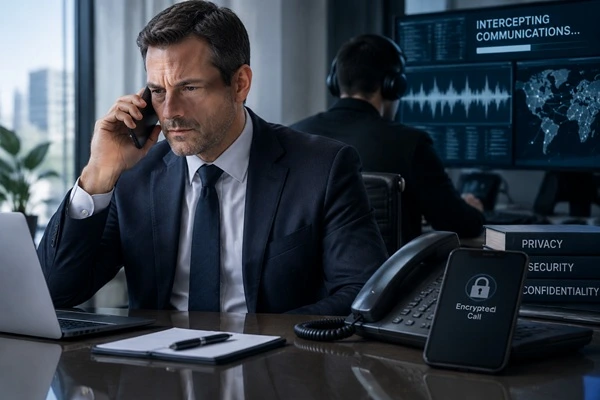
Are our telephone conversations really private? The question has become increasingly important as communications have moved from traditional landlines to mobile networks, VoIP services, smartphones, and Internet-based calling platforms.
At the same time, the technologies used to collect, transmit, and store information have become considerably more powerful. What was once possible only with specialized equipment can now involve multiple communication channels and very large quantities of digital data.
For companies, professionals, executives, and organizations dealing with confidential information, the real issue is therefore not whether every conversation is being monitored, but whether sensitive communications are adequately protected against unauthorized interception.
From Mass Data Collection to Communication Security
For many years, intelligence agencies such as the US National Security Agency have attracted public attention because of their capabilities for collecting and analyzing communications and other digital information.
These large-scale systems demonstrate a broader technological reality: modern communications generate enormous quantities of data that can potentially be collected, processed, analyzed, and stored.
However, interception is not exclusively associated with government intelligence operations. In the private and corporate environment, unauthorized access to communications may also involve industrial espionage, information theft, compromised devices, physical surveillance equipment, or unauthorized access to telecommunications infrastructure.
What Is Telephone Eavesdropping?
Telephone eavesdropping generally refers to the unauthorized interception or monitoring of a telephone conversation.
The techniques involved can vary considerably depending on the communication technology being used. Traditional telephone lines, mobile phones, smartphones, and Internet-based communications all have different potential points of exposure.
With traditional fixed telephone systems, for example, interception may involve physical access to the telephone line or equipment connected to it. Specialized landline bugging devices illustrate how audio or telephone signals can potentially be accessed when physical infrastructure is exposed.
Modern smartphones introduce an entirely different environment because a single device may handle voice calls, messaging, email, documents, video conferences, cloud services, and other sensitive information.
Why Business Conversations Can Be Valuable
Most telephone conversations contain nothing of particular value to an unauthorized listener. Business communications can be different.
A conversation between executives, engineers, consultants, lawyers, sales managers, or other professionals may reveal information that has significant commercial value.
Sensitive conversations may concern:
- business negotiations and contracts
- pricing strategies
- new products and technologies
- customer or supplier information
- mergers and acquisitions
- financial information
- intellectual property
- internal corporate decisions
For this reason, communication security should be considered part of a broader corporate information-security strategy rather than simply a matter of personal privacy.
Can a Telephone Conversation Be Intercepted?
There is no single method of telephone interception. The potential attack surface depends on the type of communication system, the device being used, the network, and the physical environment.
A traditional telephone line presents different risks from a smartphone connected to mobile and Wi-Fi networks. Likewise, protecting the transmission of a call does not automatically protect the physical environment where the conversation takes place.
This distinction is important because communication security is only as strong as the weakest component involved.
Encryption and Secure Telephone Communications
One of the principal technologies used to protect digital communications is encryption.
Instead of transmitting information in a form that can immediately be understood, encryption transforms the data using cryptographic algorithms and keys. When properly implemented, intercepted data should not reveal the original conversation without the required cryptographic credentials.
Professional encrypted phones are designed for situations where protecting confidential communications is a priority.
The objective is not simply to hide the existence of a communication, but to protect its contents against unauthorized access.
Encryption Alone Is Not Enough
An important point is often overlooked: even strong encryption cannot compensate for every possible security weakness.
If a device itself has been compromised, if unauthorized software has access to the microphone, or if a conversation can be captured directly from the room where it takes place, protecting only the communication channel may not be sufficient.
For organizations handling highly confidential information, communication security may therefore involve several layers of protection:
- secure communication devices
- encrypted voice communications
- controlled access to smartphones and computers
- regular software and security updates
- physical security of meeting areas
- verification of telephone and network infrastructure
- professional counter-surveillance procedures when appropriate
Telephone Security Is Part of a Larger Security Strategy
The enormous growth in digital communications has changed the meaning of telephone privacy. A telephone is no longer simply an instrument for transmitting voice. Modern smartphones are complete communication platforms containing messages, contacts, documents, location information, credentials, photographs, and access to corporate services.
Protecting a confidential conversation therefore requires more than worrying about whether someone is physically listening to a telephone line.
Organizations should consider the entire communication chain: the device, operating system, network, transmission method, physical environment, and people who have access to them.
Protecting Sensitive Conversations
The most effective approach is based on the sensitivity of the information being discussed. Ordinary conversations do not require the same level of protection as negotiations involving confidential financial information, intellectual property, strategic decisions, or other restricted corporate data.
Where confidentiality is particularly important, professional communication security solutions can add an additional layer of protection. Endoacustica Europe provides technologies for both the analysis of interception risks and the protection of sensitive communications, including secure encrypted telephone systems.
Ultimately, the objective is not to assume that every telephone conversation is being intercepted. It is to understand where genuine vulnerabilities may exist and apply an appropriate level of protection to communications that actually need to remain confidential.