
Endoacustica offers, Exclusive Customer Service and free Training
 IT

Discreet microphones for live audio and recording
Spy Microphones for Live Listening and Recording
Spy microphones capture conversations discreetly in rooms, vehicles or wearable setups. Their small size makes them suitable for installations where a conventional microphone or handheld recorder would be conspicuous. Depending on the device, you can listen live from another location, save recordings for later playback, or do both.
A wireless spy microphone may send audio over Wi-Fi, a cellular network, a direct radio link or Bluetooth. The connection determines whether you listen through a phone call, an app or a dedicated receiver. This guide explains those differences and what to check before choosing a device.
Live Listening and Recording Are Different Functions
Follow a conversation as it happens
A live listening device sends the microphone’s audio to you while the conversation is taking place. A GSM device can deliver it through a phone call, a Wi-Fi device through an app, and a radio transmitter through a compatible receiver.
This is useful when an operator needs to hear an event immediately. The connection must remain available for live audio to reach the listener.
Save audio for later review
A recorder stores audio in internal memory or on a memory card. You can review the conversation afterward without having listened throughout the session.
Some devices combine both functions. PICO2, for example, supports live listening and local recording; it can continue recording to microSD when Internet access is unavailable.
For devices focused on saving conversations, browse our miniature voice recorders. For the full range of live listening technologies, visit the professional listening device catalog.
How Can You Listen to a Hidden Microphone from Your Phone?
Wi-Fi: live audio and recordings through an app
A Wi-Fi listening device connects to a configured network with Internet access. Its app lets you listen from another location. On models with onboard recording, the app can also provide access to saved audio.
PICO2 uses 2.4 GHz Wi-Fi or a phone hotspot for live audio and remote downloads through its Android or iOS app. Bluetooth is used for initial pairing, not for carrying the live audio stream.
GSM: listen through a phone call
A GSM listening device uses a SIM card and the cellular network. On call-based models, you dial the device’s number to hear its microphone. This provides remote listening without a local Wi-Fi network, wherever compatible cellular voice service is available.
Network compatibility matters when selecting a device for the United States: a GSM-only model requires an operating GSM network and cannot be assumed to work on an LTE-only service.
Bluetooth: a local wireless connection
Bluetooth audio devices communicate with a supported phone or computer nearby. On models such as MR-NANO and ECHO, Bluetooth also supports recording downloads. To reach these devices over the Internet, a compatible gateway provides the network connection and communicates with the recorder over Bluetooth.
Radio: listen through a dedicated receiver
An analog radio microphone transmits directly to a receiver matched to its frequency and modulation. It does not need a SIM or Internet connection. A standard smartphone does not replace that receiver. See the radio audio bug guide for receiver requirements.
Three Examples of Live Audio Connections

PICO2: Wi-Fi listening and recording
Live audio through an Android or iOS app, remote recording downloads and local WAV recording to microSD up to 128 GB. Uses a 2.4 GHz Wi-Fi network or phone hotspot.
The module measures 45 × 25 × 6 mm, excluding the battery. Continuous and voice-activated recording work offline.
View PICO2 Details ↗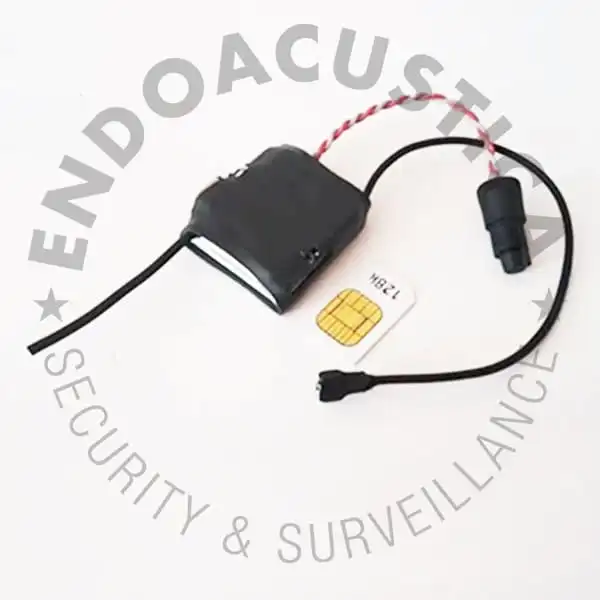
NANO-BUG: Live listening by phone call
A 31 × 31 × 10 mm GSM listening device with SMS configuration, sound and motion alerts, and automatic callback. Audio is received through a phone call rather than a Wi-Fi app.
Uses quad-band GSM at 850/900/1800/1900 MHz. Confirm compatible cellular voice coverage for the country and network where it will operate.
View NANO-BUG Details ↗
SPUTNIK: Direct UHF radio transmission
A miniature transmitter with an external microphone and wire antenna. The transmitter body measures 9 × 18 × 2.8 mm and operates on 2.8–4.5 V DC.
Sends live audio to a compatible radio receiver without cellular service or Wi-Fi. The battery, microphone and antenna form part of the complete assembly.
View SPUTNIK Details ↗What Makes Speech Clear Enough to Review?
A sensitive microphone picks up quiet sounds, but it also picks up background noise. Speech clarity depends on the distance between the microphone and the speaker, room acoustics and competing sounds. Increasing sensitivity alone does not isolate a conversation.
Automatic gain controlAGC adjusts the audio signal level as sound levels change. It does not separate a voice from every background sound. helps manage changes in sound level on equipped models. Digital processing can reduce some noise, but the microphone still needs to capture usable speech in the first place.
Transmission range is not microphone pickup distance
Radio range describes the distance between transmitter and receiver. It does not describe how far away a conversation can be from the microphone. A network-connected device may send audio to a listener many miles away while its microphone captures speech in the room where it is installed.
For this distinction in more detail, read our long-range audio surveillance guide. Directional microphones address a different task: capturing sound from a particular direction. Those systems are covered in the directional microphone category.
Size, Power and Voice Activation
A mini spy microphone’s dimensions may refer only to its electronic module. Include the battery, antenna and any external microphone when assessing the space required. For wearable use, thickness and flexibility matter as well as overall size; see our guide to hidden microphones for clothing.
Compare battery life for the mode you plan to use. Continuous streaming, recording and standby consume different amounts of power. External power supports extended operation where a suitable supply is available.
Voice activationVOX triggers an action when sound exceeds a configured threshold. Voices and other sounds can activate it. can trigger different actions: NANO-BUG can call a preset number when sound is detected, while PICO2 can start recording. Choose the function that fits how you want to receive the audio.
Protecting Access to Audio
Access controls and encryption serve different purposes. Authorized phone numbers or app pairing restrict who can connect. Encryption protects audio or files using cryptographic keys. A small housing or a wireless connection does not itself provide encryption.
For equipment designed around protected audio transmission, explore our encrypted listening systems.
Frequently Asked Questions About Spy Microphones
Can I listen to a spy microphone live from my phone?
Yes, with a device designed for phone access. A GSM model can deliver audio through a call; a Wi-Fi model such as PICO2 streams through an app. Analog radio transmitters require a compatible receiver.
Does a wireless spy microphone need Wi-Fi?
No. Wireless can mean Wi-Fi, cellular, Bluetooth or a direct radio link. The technology determines whether you need a network, a nearby supported device or a radio receiver.
Can a hidden microphone record without an Internet connection?
A device with onboard recording can save audio locally without Internet access. PICO2 supports offline recording to microSD. Live remote access and file downloads require its network connection.
Can Bluetooth send audio to my phone from another city?
Bluetooth is a local connection. Remote Internet access requires a compatible gateway that connects to the audio device over Bluetooth and provides the Internet link.
Does a longer transmission range mean better microphone pickup?
No. Transmission range describes how far audio can travel to the listener or receiver. Microphone pickup depends on speaker distance, sound level, background noise and acoustics.
Does voice activation start a recording or call my phone?
That depends on the model. PICO2 uses voice activation to start recording; NANO-BUG supports automatic callback when sound is detected. These are different functions.
Will a GSM spy microphone work on any U.S. mobile network?
No. A GSM-only device needs compatible GSM voice service. Check the supported network technology and local carrier service before selecting a cellular listening device.
What is the difference between a microphone and a complete listening device?
A microphone converts sound into an electrical signal. A complete listening device also includes the electronics needed to transmit or record that signal, plus a power source. A miniature microphone module may require separate recording or transmission equipment.
Choose a Microphone for the Way You Need to Listen
Tell us whether you need live audio, saved recordings or both, how long the system must operate and which connections are available. We can help select a suitable device.