
Endoacustica offers, Exclusive Customer Service and free Training
 IT
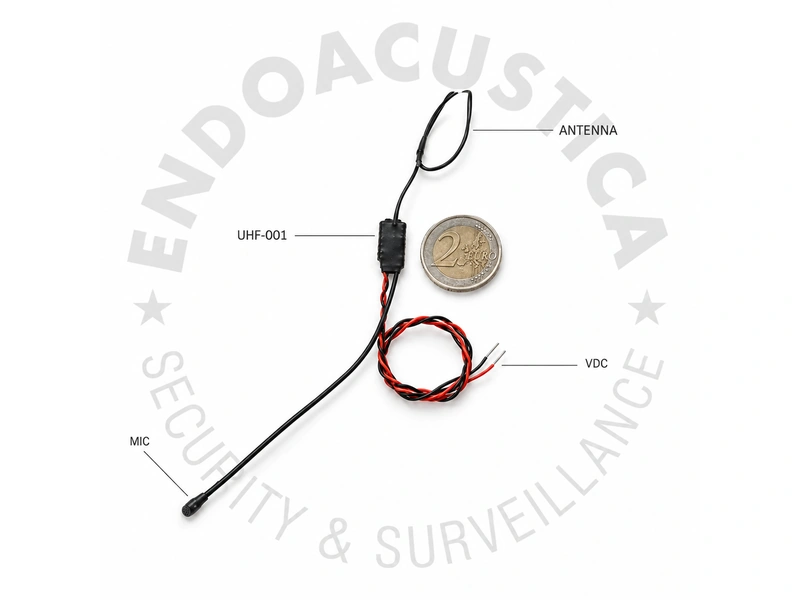
Discreet listening over a direct radio link
Radio Audio Bugs: How They Work and What Receiver You Need
A radio audio bug captures conversations through a miniature microphone and transmits the sound directly to a compatible receiver. You listen as the conversation happens, without a SIM card, cellular coverage or Internet connection.
The transmitter and receiver work as a pair. Frequency, reception mode and antenna performance all affect whether you receive clear audio. This guide explains what to match and how to interpret range and power specifications. For available models, visit our analog audio transmitter catalog.
From Microphone to Receiver
The microphone converts sound into an electrical signal. The transmitter uses that signal to modulate a radio carrier, which travels to the receiver. The receiver tunes to the carrier and recovers the audio for playback through headphones or a speaker.
Conversation → Microphone → Radio transmitter → Compatible receiver → Headphones or speaker
The microphone stays near the conversation; the receiver allows listening from another location within radio range. A direct RF link is useful when the listening system needs to operate independently of local Wi-Fi or mobile service.
For a broader comparison of live listening and stored audio, see our spy bugs guide.
Choosing a Compatible Receiver
Match the frequency and reception mode
“UHF” identifies a frequency band, not a universal connection standard. The receiver must tune to the transmitter’s actual operating frequency and support the correct modulation and bandwidth.
For example, WFMWideband frequency modulation. A receiver must support the appropriate FM bandwidth to recover the transmitted audio correctly. transmitters need suitable wideband FM reception. A receiver that covers the frequency but only offers an unsuitable mode may produce distorted audio or no usable audio.
Check how you will listen and record
Headphone connections, audio outputs and recording functions determine how you use the received sound. For recording, choose a receiver with that capability or a compatible output for an external recorder.
If you already own a receiver, provide its model and the transmitter’s frequency before ordering. That makes it possible to check the pairing rather than selecting equipment by the “VHF” or “UHF” label alone.
Transmission Range Is Not Microphone Pickup Distance
A stated range of 300 meters describes the distance between the transmitter and receiver. It does not mean the microphone can capture a conversation from 300 meters away.
Microphone pickup depends on voice level, background noise and room acoustics. Radio reception depends on the transmitter’s output, receiver sensitivity, antennas and the path between them. Walls, metal structures and interference can affect the usable link.
Open-field figures provide a reference for comparing systems. Evaluate them alongside the intended environment and receiver, rather than treating the transmitter’s power rating as a range guarantee.
Two Power Options, Two Different Uses

SPUTNIK: miniature low-voltage transmitter
A 9 × 18 × 2.8 mm transmitter body with an external microphone and flexible wire antenna. It operates on 2.8–4.5 V DC, allowing a suitable battery to be selected for the application.
Its specified open-field range is approximately 300–400 meters. Include the battery, microphone and antenna when assessing the complete assembly’s size.
View SPUTNIK specifications ↗
UHF-220B: continuous external power
A UHF transmitter designed for a 220 V AC supply, with a Knowles microphone and automatic microphone preamplifier control. It measures 35 × 20 × 4 mm and uses WFM modulation.
External power supports ongoing operation without battery replacement. The 220 V supply requirement remains the same for this model, including orders for the U.S. market.
View UHF-220B specifications ↗Battery Runtime, Voice Activation and Remote Control
A battery-powered transmitter offers flexibility where a fixed power source is unavailable. Runtime depends on battery capacity, current consumption and operating mode. Compare continuous-transmission figures with continuous-transmission figures, not with standby time.
Some models support VOXVoice-operated switching: a function triggered when sound exceeds a selected threshold., allowing transmission to start when sound is detected. Other models offer remote on/off control. These features can reduce unnecessary operating time, but they are model-specific; they should not be assumed for every radio bug.
Radio Bugs vs. GSM and Wi-Fi Listening Devices
With a radio bug, the receiver is part of the listening system and must stay within the usable RF link. A GSM listening device uses the mobile network, while a Wi-Fi device such as PICO2 provides remote listening through an Internet-connected app.
Choose direct radio when independent transmitter-to-receiver operation is the priority. Choose a network-connected system when you need phone or app access beyond a local radio link. Our professional listening device catalog covers these different technologies.
Analog Transmission and Audio Confidentiality
A direct radio connection is not automatically encrypted. If protecting the transmitted conversation is a requirement, use a system with specified encryption and compatible receiving equipment. See our encrypted audio transmitters for that product family.
If you are looking for equipment to locate a suspected transmitter rather than listen through one, visit the counter-surveillance category.
Frequently Asked Questions About Radio Audio Bugs
What is a radio audio bug?
A radio audio bug is a compact microphone and transmitter that sends sound directly to a compatible radio receiver. It provides live listening without a SIM card or Internet connection.
What receiver do I need for an analog audio bug?
The receiver must cover the transmitter’s operating frequency and support its modulation and bandwidth. For example, a WFM transmitter requires a receiver with suitable wideband FM reception. Matching only the VHF or UHF band is not enough.
Can I listen to a radio bug on my phone?
A standard smartphone cannot receive a dedicated UHF audio transmitter directly. You need a compatible radio receiver. GSM and Wi-Fi listening devices offer different ways to access audio through a phone call or app.
How far can a radio audio bug transmit?
Range depends on the transmitter, receiver, antennas and surroundings. SPUTNIK has an open-field range of approximately 300–400 meters. This describes the radio link, not the distance from which its microphone can pick up a conversation.
Do radio bugs work without cellular coverage?
Yes. The transmitter sends audio directly to the receiver, so the link does not depend on cellular service or Internet access. The receiver must remain within usable radio range.
Does an analog radio bug record conversations?
Transmission and recording are separate functions. To save audio, use a receiver with recording capability or an external recorder connected through a suitable audio output. Do not assume that the transmitter has onboard storage.
Are analog radio bugs encrypted?
An analog radio link is not automatically encrypted. If audio confidentiality is required, select a system with specified encryption and a compatible receiver.
What is the difference between VOX and remote control?
VOX activates a function when sound exceeds a selected threshold. On a transmitter equipped for voice-activated transmission, it can start the radio link automatically. Remote control lets an operator switch a supported device on or off. Availability depends on the model.
Find a Transmitter and Compatible Receiver
Browse the radio transmitter range, or send us the receiver model you already use and the type of audio connection you need.