
Endoacustica offers, Exclusive Customer Service and free Training


FALENA · Directional microphone
Directional microphone array system with DSP and recording
FALENA combines microphone-array processing and digital recording in a portable system for professional speech monitoring. Two simultaneous inputs, configurable DSP and up to five cascaded filters support audio capture at a stated maximum distance of approximately 150–300 m (490–984 ft), depending on the array and listening conditions.
- Two microphone inputs with independent processing.
- Automatic level control, programmable noise gate and digital filters.
- Up to 60 dB input gain in 0.1 dB steps.
- 4.3-inch color capacitive touchscreen.
- Internal rechargeable lithium-ion battery.
Product code: FALENA
Price on request
Specify your listening environment, distance and required array functions.
Technical consultation, training and support.
+39 080 302 6530
Array-based speech capture with configurable DSP
Two simultaneous inputs
Apply filters and automatic level control independently to each microphone input.
Up to five cascaded filters
Configure a processing chain for the available signal, with presets for traffic and other environmental noise.
Analog and digital arrays
Choose an array configuration for the listening task. Electronic beam steering requires the equipped digital-array version.
Full description
Portable processing and recording for microphone arrays
FALENA integrates audio processing and recording in a 180 × 130 × 40 mm unit. Connected to a suitable microphone array, it captures speech from a separate monitoring position. The stated maximum listening distance is approximately 150–300 m (490–984 ft), depending on array configuration, source level and environmental noise.
Two inputs operate simultaneously, each with its own filtering and automatic level control. A sunlight-readable 4.3-inch color capacitive touchscreen gives the operator local access to audio settings and system parameters.
DSP controls for challenging acoustic conditions
Processing options include automatic level control (ALC), a programmable noise gate, and band-pass, low-pass, high-pass and notch filters. Up to five filters can be cascaded at once.
Presets address interference associated with power lines and electromagnetic fields, traffic noise and broadband urban noise. The operator can adjust processing to the available audio, rather than relying on a single fixed filter setting.
48-microphone analog array and digital beam steering
Photo A shows an analog array with 48 microphones. Their signals are summed to improve directionality and signal-to-noise performance. The panel is physically aimed toward the source.
Photo B shows a digital configuration with four panels of 20 microphones each: 80 capsules across a 40 × 32 cm assembly. A low-power FPGA processes the individual signals to form and steer the listening beam electronically within the configuration’s operating capabilities.
FALENA versions are available with or without the cabling and software needed for electronic beam control. Digital signal transfer reduces susceptibility to interference associated with low-level analog connections.
Memory-card recording and local control
Audio is stored on a memory card. The listed recording capacity is approximately 45 hours per card for one channel of uncompressed audio.
The internal 12 V rechargeable lithium-ion battery provides up to 24 hours under ideal conditions with power saving enabled. Actual runtime varies with use. Local operation uses the touchscreen. Browser-based network control and remote self-test are described as planned features; the supplied documentation states that the remote-control option has not yet been implemented.
Technical specifications
| Model | FALENA |
|---|---|
| Microphone inputs | Up to two simultaneous inputs, each with filters and/or ALC |
| Audio response | 50–3,800 Hz; +0.1 dB as listed; default sampling rate 8 kHz |
| Signal-to-noise ratio | >93 dB, A-weighted |
| Microphone input dynamic range | 95 dB |
| Maximum input gain | 60 dB in 0.1 dB steps |
| Noise gate threshold | −90 to −30 dBFS |
| ALC gain range | 0 to +58 dB |
| DSP functions | ALC, noise gate, band-pass, low-pass, high-pass and notch filters |
| Cascaded filters | Up to five simultaneously |
| Display | 4.3-inch color LCD with capacitive touchscreen |
| Stated maximum listening distance | Approximately 150–300 m (490–984 ft), depending on array and conditions |
| Illustrated analog array | 48 microphones |
|---|---|
| Illustrated digital array | Four panels with 20 microphones each; 80 total |
| Illustrated digital array dimensions | 40 × 32 cm |
| Electronic beam steering | Requires digital array and version with dedicated cabling and software |
| Recording capacity | Approximately 45 hours per card; one channel, uncompressed audio |
| Recording medium | Memory card |
| Internal battery | 12 V DC rechargeable lithium-ion |
| Battery runtime | Up to 24 hours under ideal conditions with power saving enabled. Actual runtime varies with use. |
| Operating temperature | −20 to +60 °C |
| Storage temperature | −30 to +80 °C |
| Unit dimensions | 180 × 130 × 40 mm |
| Local control | Touchscreen graphical interface |
| Remote control | Planned embedded web server; not yet implemented in the supplied documentation |
| Remote self-test | Planned with network control |
Applications
Investigative audio monitoring
Capture and record speech from a distant listening position, selecting the array to suit the scene and acoustic conditions.
Area and perimeter monitoring
Monitor from a fixed position with DSP settings tailored to persistent noise. The equipped digital-array version supports electronic beam steering.
Noisy environments
Use filtering and the noise gate to adjust pickup around traffic or sustained interference, with local control of processing parameters on the display.
Technical consultation and support
Array selection
Discuss the listening distance and environment to assess analog and digital array options.
System configuration
Review the cabling, software and beam-control features included in the selected version.
Setup and training
Get guidance on array positioning, DSP settings and recording operation.
Explore the range
Related products
Compare other directional listening systems with parabolic reflectors or individual directional microphones.
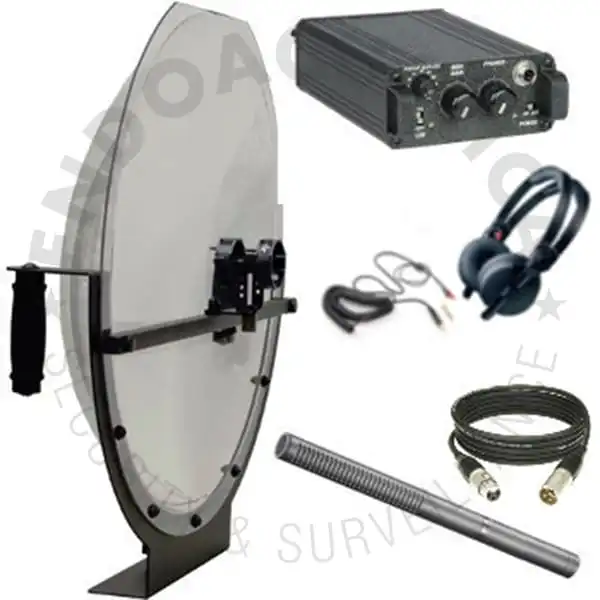 EAGLE
Parabolic directional microphone
Dish-based system for listening to distant sound sources.
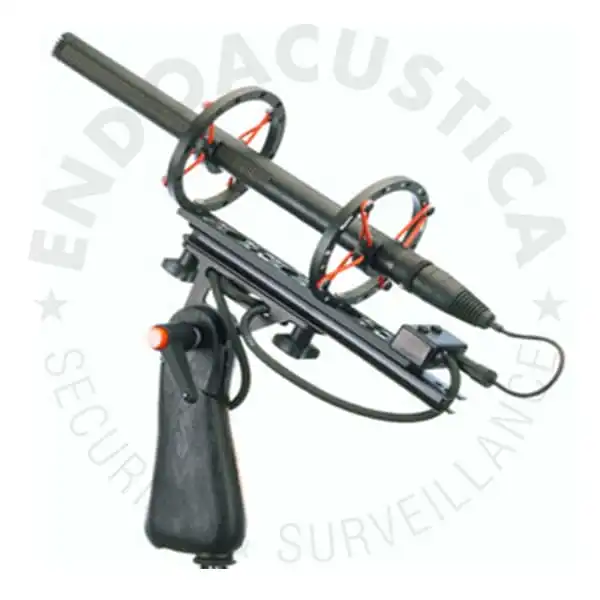 KMR-359
Supercardioid directional microphone
Alternative directional listening kit with a supercardioid pickup pattern.
 EN-SH89
Professional shotgun microphone
Directional microphone with a dedicated preamp and selectable filters.
 MEGA-EAR
 parabolic microphone
Parabolic microphone system for directional listening at a distance.
Discuss your requirements
Configure your FALENA audio system
Tell us about the listening environment, distance and processing requirements. We can help select the array and system version.
Or call us: +39 080 302 6530